
As humans, we go through many transitions in our lives, all of them transformative in some way. Arguably, the most profoundly transformative experience is becoming a mother. The changes are physiological, psychological, emotional, familial, vocational, and the list goes on and on.
These days, we have an app for nearly every aspect of pregnancy and motherhood, a multitude of gadgets, and manuals for every stage of parenting. Capitalism has taken hold of pregnancy and motherhood and created a long list of “must-haves” for anxious first-time moms. How did mothers get by before the internet and Amazon’s two-day delivery?
Well, they had the village — you know, the one they say it takes to raise a child. That village consisted of mothers, grandmothers, aunts, sisters, midwives, and village elders. Knowledge was passed down from mother to daughter, and grandmothers were a valuable resource and fountain of wisdom and experience. In the 1800s, the medical world inserted themselves into birthing practices. Midwives were vilified and traditional practices were termed barbaric and uncivilized. Practitioners were subject to legal action for providing the same care they had provided for generations.
THE IMMIGRANT GENERATION GAP
Although there has been a resurgence in traditional healing practices, stigma persists. Traditional practices are often only considered valid when adopted in North America and marketed with a celebrity stamp of approval.
What does this look like when you’re the child of an immigrant, growing up between two worlds? For South Asians, it might look like rejecting the Haldi Dudh your grandma made for you but paying $7 for a golden milk latté at a coffee shop. The benefits of turmeric (in both products) are only valid when you read an article or see a favourite influencer raving about it.
Now, you might argue that evidence and research are needed to support benefits that traditional healing practices assert, but how many of us actually look up peer-reviewed studies to validate the claims? Or is this just another tactic to de-legitimize anything outside of the colonial frame of reference?
Children growing up in Canada in immigrant homes have long struggled to reconcile their home life with their school life, often rejecting their cultural heritage in favour of the dominate culture. Asking their moms to pack them a bologna sandwich for lunch instead ethnic foods and leaving their immigrant mothers perplexed as to how slapping cold meat between two slices of bread is better. The child’s preference for western culture is reinforced when no one comments on their lunch or makes a face at the foreign aroma emanating from their lunchbox. Thus starts the rejection of remnants from the motherland, and the immigrant generation gap forms. This gap widens as the child develops and forges their individual identity, an identity they may have to hide from the collectivist nature of their family home.
GENDER DIFFERENCES
A factor that contributes to conflict between parents and their daughters in immigrant homes is that gender differences can be more pronounced compared to their western counterparts. The impact on the female children of immigrants is significant. Mothers often play a vital role in reinforcing patriarchal norms through modelled behaviour and explicit expectations.
The mother-daughter relationship in these homes is complicated, to say the least. The role of the eldest daughter in an immigrant home is widely recognized on social media as a trauma-laden experience. The role often places the child in a parentified position, carrying emotional labour, responsibility for younger siblings, and the added burden of navigating English-speaking systems for parents who are not native speakers.
The rebellious teen years are particularly damaging to this mother-daughter relationship. The teenage daughter longs for freedom, and the conservative immigrant mother fears the repercussions of allowing that freedom. They enter a complicated dynamic, where the daughter has no choice but to lie, and the mother grapples with the impending loss of control. Their worlds further split when the daughter finds a partner.

The daughter then settles into her role as a wife in a home that doesn’t look much like her childhood home but instead looks more like the homes she grew up watching on TV. She doesn’t use plastic yogurt containers to store leftovers — she buys glass containers made for the purpose. She doesn’t have mismatched dishes in her cupboards, her sofa is not wrapped in plastic, and her shelves are not lined with newspaper. She doesn’t see the woman who raised her anywhere in the woman she is today. Instead, she sees a home and woman that look like the ones on her social media channels. She feels like she has finally forged an identity of her own, not realizing that she was simply being influenced to value herself based on her proximity to whiteness and western culture. And why wouldn’t she? The main messaging she’s received as a child of an immigrant is to fit in, be like the majority, and you will be accepted.
But what happens when this woman becomes a mother herself? So much of how we parent is based on how we were parented. We might do the opposite because we remember how we felt — or we replicate how we were parented because we remember how we felt. How does she reconcile being a mother, when her closest frame of reference is her own mother, a woman that does not align with how she sees herself?
POSTPARTUM TENSIONS
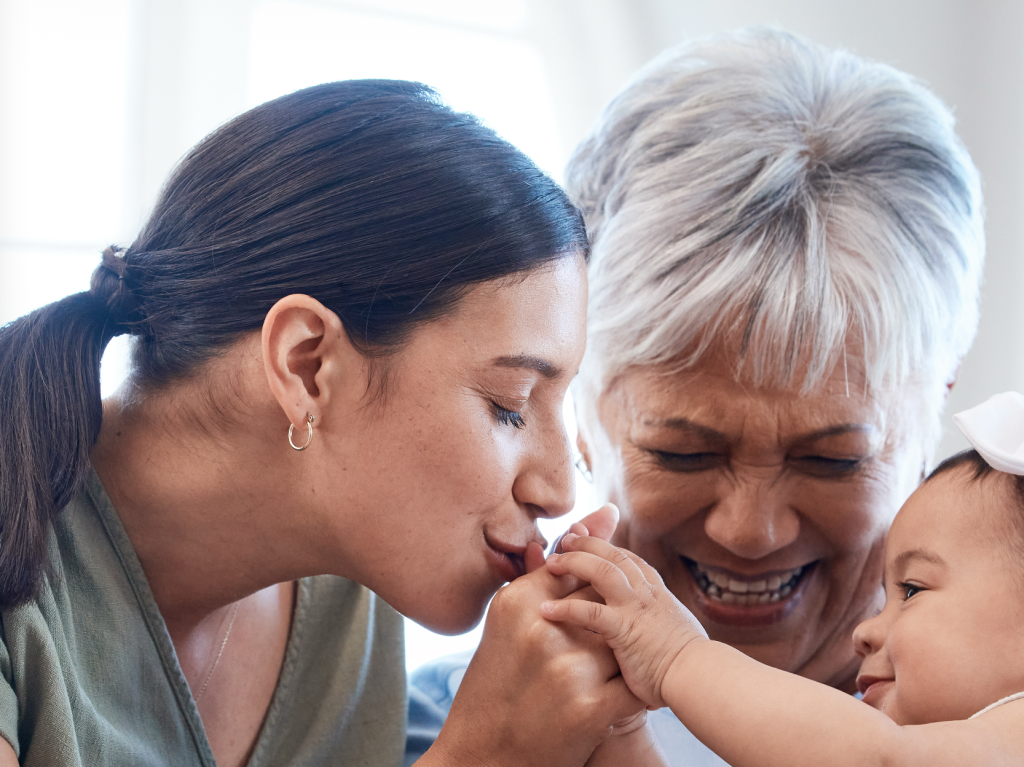
Many of the reproductive mental health clients I see in my practice come from immigrant homes, whether South Asian, Chinese, Filipino, Korean, or Persian. The overwhelming majority express tensions with their immigrant moms during the early postpartum days. These grandmothers are often beyond excited — chomping at the bit — to be involved with their new grandchild. However, the new mom is often apprehensive, unsure about the remedies being suggested — and sometimes forced — for the baby’s well-being.
I would like to mention that this tension may also occur in families of European descent, even when the new mothers are third- or fourth-generation Canadians. Differences in childrearing practices across generations can become a source of conflict between any new moms and new grandmas.
However, for children of immigrants, this tension is often rooted in the new mother’s preference for the medical model. The ancestral knowledge our mothers and grandmothers carry may not be scientifically validated (yet). When we are raised in a culture that emphasizes science and research, trusting traditional wisdom can feel ridiculous and even dangerous. This tension can leave the grandmother feeling rejected and unvalued.
This rejection is further cemented when the grandmother sees how much more involved the new fathers are. The spot next to her daughter at the birthing bed is occupied by her son-in-law. Birth was traditionally a time when the women came together, both sets of grandmothers prepared meals together and shared their own stories of birth and early motherhood. It is a chance to reconnect with a life they gave so much to and an opportunity for their children to see the depth of effort, care, and sacrifice that goes into motherhood — a chance to deliver that age-old line: “Now do you understand, now that you have kids of your own?”
HOW TO HELP
As a therapist, helping clients navigate these relationships is multi-layered. For some, it involves dethroning the parent and seeing them as an equal. Asking questions like, how would you feel about this person if she was your classmate? It may involve perspective taking — considering their parent’s migration journey and how they would navigate a new country when they have little community and don’t understand the language or culture.
Trying to enforce boundaries is not going to benefit either party and will likely lead to further distress. These grandmothers can be the greatest allies in the early trenches of motherhood — a remnant of the village to which we once belonged. Is a boundary even going to be helpful or possible? In most cases, the answer is not likely.
In my experience, most of these grandmothers refuse to go to therapy themselves. They do not want to discuss their traumas and resentments.
Instead, the work is done through the new mother clients finding compassion for their mothers but also honouring their own very real hurts and childhood resentments.
For example, a common trope in immigrant households is the parent that doesn’t say, “I love you” or “I’m sorry” but instead brings fruit or tries to engage in other ways. We can guide our clients to understand that love is not necessarily expressed in the ways that we want to receive it, but that doesn’t mean it’s not there. Accepting this can be difficult, because the instinct is to “fix” their parents and make them see their faults, which leads to further frustration.
I often find it helpful to invite the client to reflect on how their grandparents may have raised their parents. This exploration can uncover difficult stories, including experiences of war, forced displacement, loss, violence, oppressive governments, abuse, and other significant traumas. Hearing these narratives can sometimes leave clients feeling guilty for expressing their own struggles or believing that their problems are less significant by comparison. Sitting with this complex mix of emotions is an important part of the healing process. It helps us see how our own stories are woven into generations of experiences that came before us.
At the same time, this web of interconnected stories doesn’t exist in a vacuum — it’s held together by the broader context of history, sociopolitical forces, economic disparities, and cultural dynamics. So as much as someone may want their parents to “fix” themselves to fit their western perspective, the parents may have a completely different context from which they are operating. The healing lies in finding compassion, taking space when needed, and looking beyond the new mother’s story to the stories that lead to a life where you can click three times and have a parcel delivered to your door in two days.
And of course, practising mindfulness when your mom offers you remedy number five that her aunt’s sister’s friend’s grandma from the village back home sent to increase breast milk supply.
All the while, acknowledging the irony that mindfulness practices originated in a village in India in the fifth century, but weren’t scientifically validated in the West until 1982 (Kabat-Zinn) and that it would take another 30 years for it to be widely accepted as a healing practice.
Perhaps, remedy number five might not be so bad after all.
Nishi Banipal, MEd, RCC, is an artist and therapist, who specializes in Maternal Mental Health, adult children of Immigrants and ADHD.
RECOMMENDED READING
But What Will People Say? Navigating Mental Health, Identity, Love and Family Between Cultures by Sahaj Kohli
Between Two Worlds: 8 Challenges as a Second-Generation Immigrant —Things About Having Immigrant Parents That No One Talks About by Imi Low
Unfinished Business: Breaking Down the Great Wall Between Adult Child and Immigrant Parents by Amy Yip
Motherhood Journey Through the Eyes of Immigrant Women — Women’s Studies International Forum by Tzu-I Tsai, I-Ju Chen, and Song-Lih Huang The Existential Crisis of Motherhood by Claire Arnold-Baker